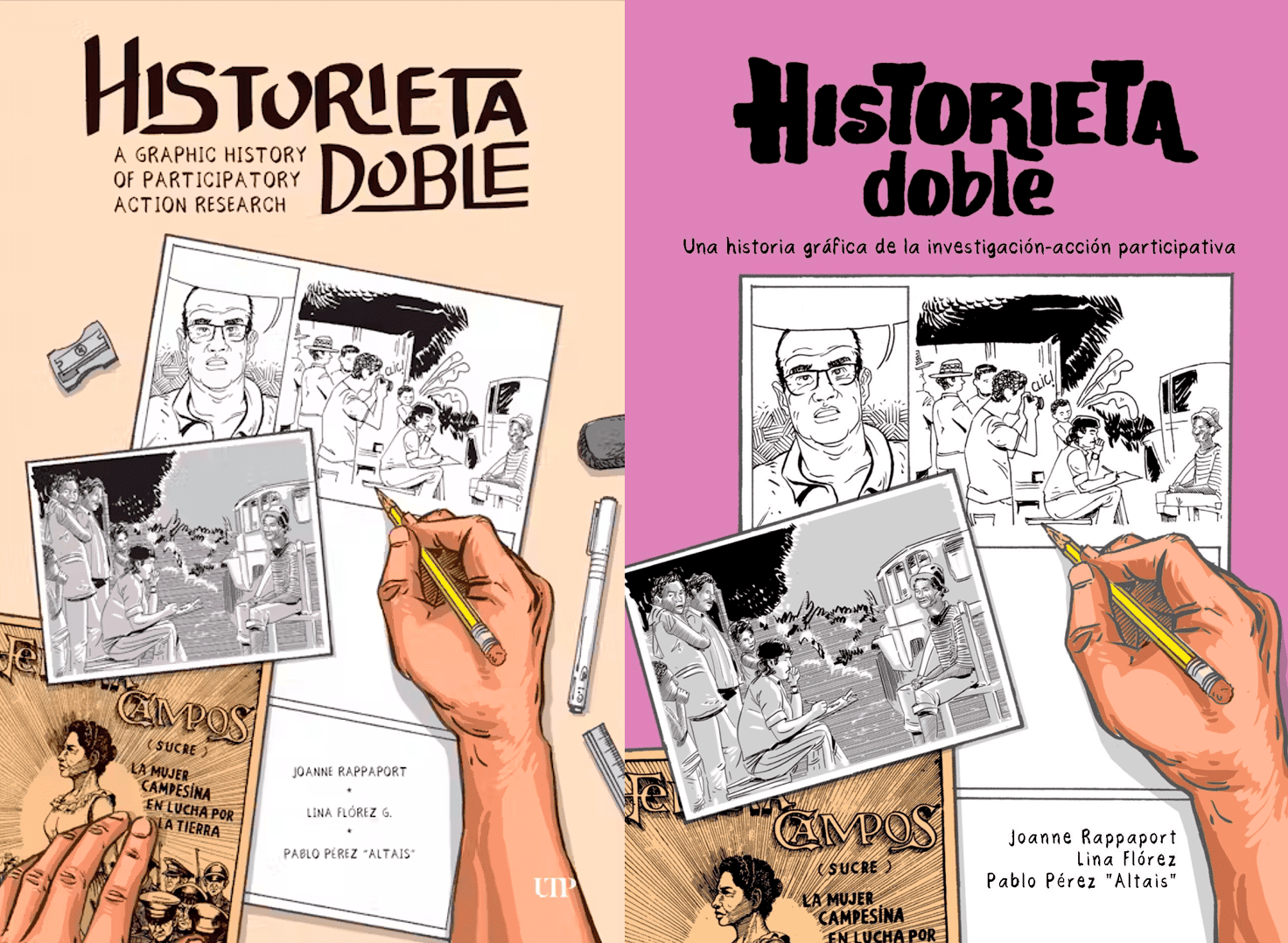
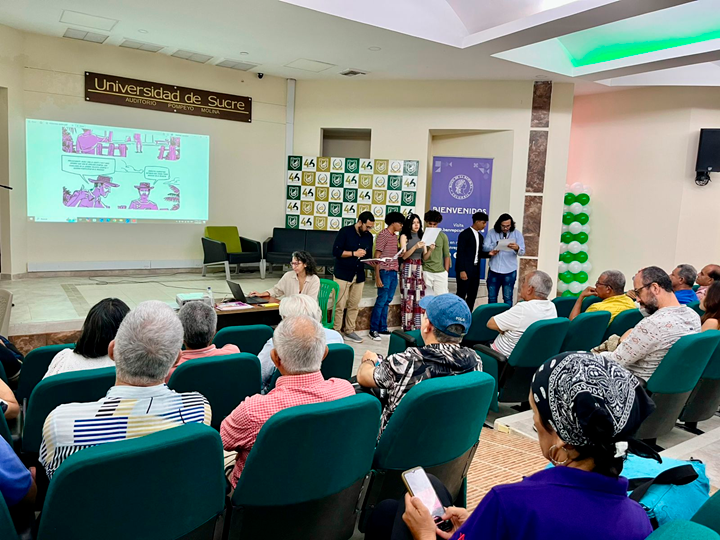
Transcript of the presentation: “Historieta Doble: The Illustrator’s Gaze in Visual Research for the Creation of Nonfiction Comics,” presented by Pablo Pérez on June 9 as part of the Training School “Comics-Based Practice and Research: Methodologies,” organized by the COS-MICs COST Action (CA24160) Comics and Sciences through Multidisciplinary Investigation and Collaboration.
- Brief personal introduction and context
Good morning, everyone.
I want to begin by thanking deeply the University of Coimbra, the COS-MICs initiative, and very especially Virginie Giuiliana and Francisca Cárcamo, Panchulei, for the wonderful invitation to be part of this Training School. It is an honor to be here, sharing with people who believe in the power of comics to transform the way we research, communicate, and feel knowledge.
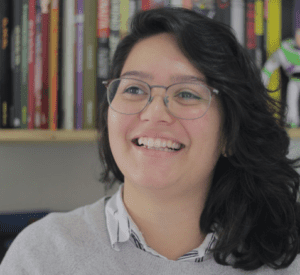
Let me briefly contextualize my work. I am Pablo Pérez, a comics artist, illustrator, and MA in Journalism. I am co-founder of the Altais Cómics collective and a professor of illustration, writing, and comic production at the Tecnológico de Artes Débora Arango, all here in the city of Medellín, Colombia. My career has been a continuous learning process about how drawing can be a form of research, and how that research becomes richer when done in collaboration with others: scriptwriters, anthropologists, historians, and of course, with the communities who are the protagonists of the stories.
Today I want to share with you a concrete experience: the creation of the book Historieta Doble: A Graphic History of Participatory Action Research. Through this example, we will explore the role of the illustrator not as a mere illustrator, but as a co-researcher who works side by side with other professionals. At the end, I propose five practical keys for each of the two central sections. Let’s go step by step.
- The authors and the genesis of “Historieta Doble”
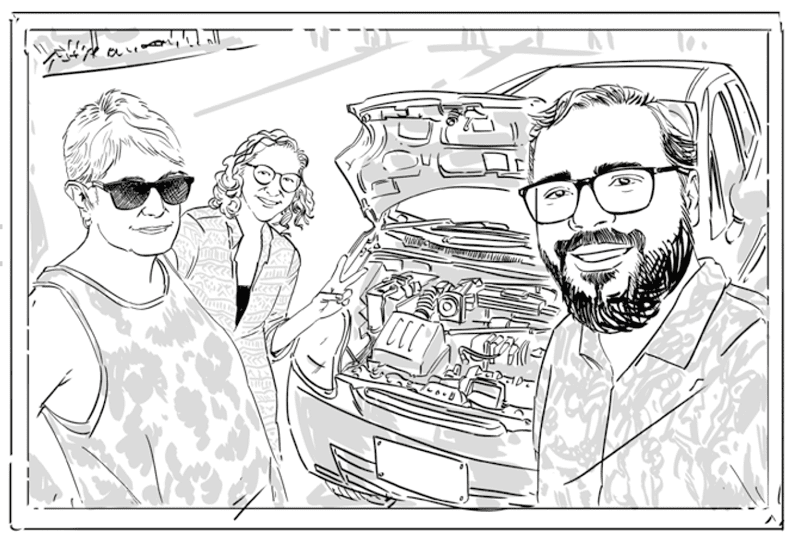
Historieta Doble was born from the meeting of three distinct perspectives: that of anthropologist Joanne Rappaport, an expert in social movements and historical memory, professor emerita of Latin American literature and cultural studies at Georgetown University (United States); that of Lina Flórez, a documentary comic scriptwriter with a unique sensitivity for visual narrative; and my own, as an illustrator and visual researcher.
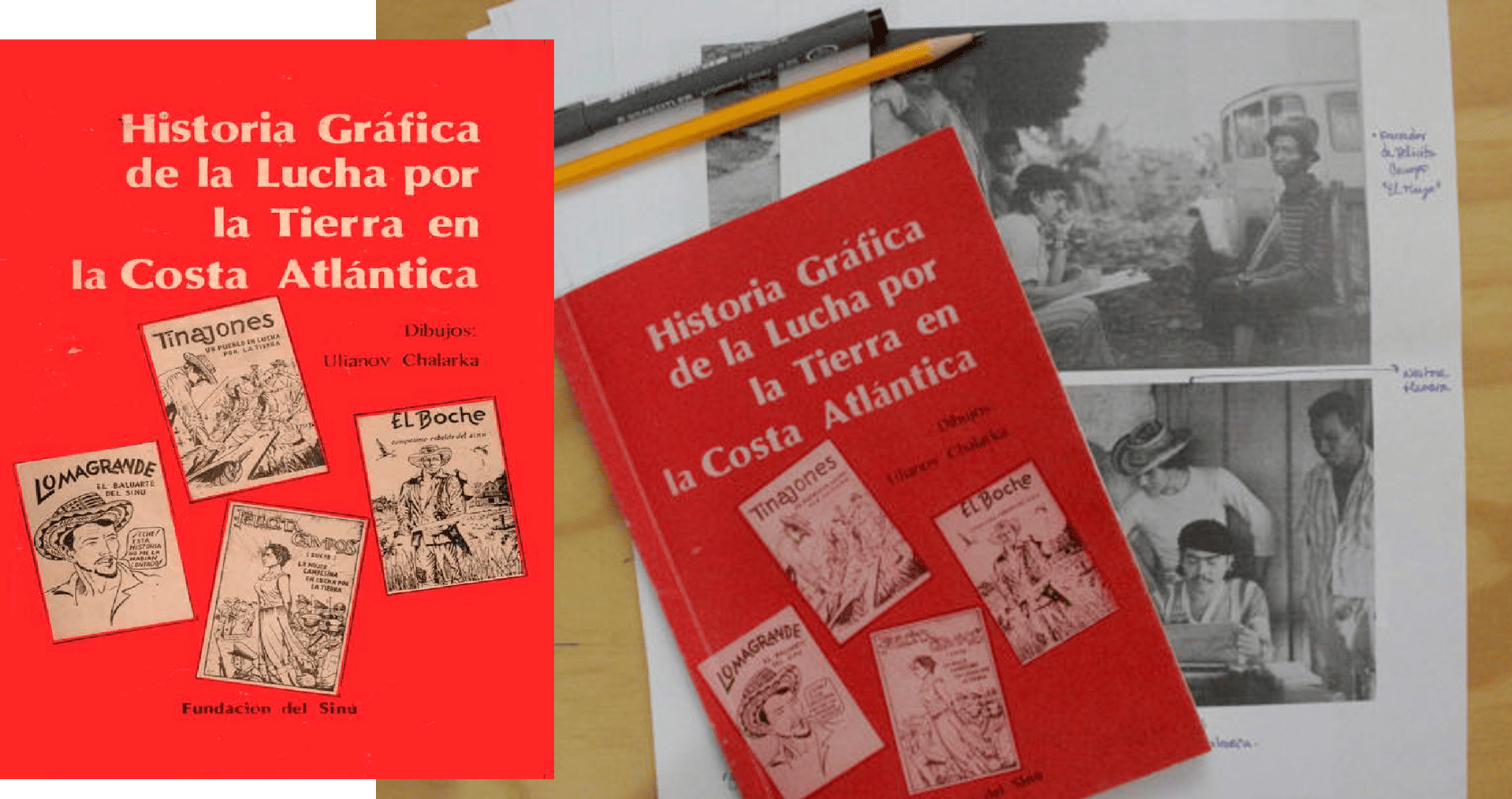
Joanne had spent years working in the archives of Orlando Fals Borda, the Colombian sociologist who was a pioneered in Participatory Action Research (PAR). In her research, she discovered that Fals Borda not only wrote academic books, but also used comics as a tool for returning information to peasant communities. Those comics were drawn by an artist named Ulianov Chalarka, a nearly forgotten but fundamental figure in the history of Colombian comics.
Joanne felt that her academic work, though rigorous, did not reach the audiences who truly needed those stories: peasants, social leaders, students. That is why she sought out Lina and me. Together we decided not only to tell the story of PAR, but also to make visible the creative process behind those original comics. In other words, we wanted the reader to see from the inside how a nonfiction comic is made, with all its doubts, decisions, and discoveries.
The title Historieta Doble reflects that duality: on one hand, the story of Fals Borda and Chalarka in the 1970s; on the other, our own research and creation process in the present. It is also a nod to Fals Borda’s classic book, Historia doble de la Costa.
But most importantly, from the beginning we understood that this project would be truly collaborative. There would be no hierarchy where the anthropologist “thinks” and the illustrators “execute.” Joanne shared her archives and her doubts; Lina built scripts that we then discussed panel by panel; I drew, but always brought the drawing back into the conversation. Every decision – from color to the size of a panel – was made as a team.
- Historical context: Chalarka, Fals Borda, and PAR
To understand the value of this collaboration, we must travel to the Colombian Caribbean coast in the 1970s. Orlando Fals Borda was developing a revolutionary method: Participatory Action Research. PAR was not desk-bound social science; it was an active commitment with peasant communities, where knowledge was built with the people, not about the people.
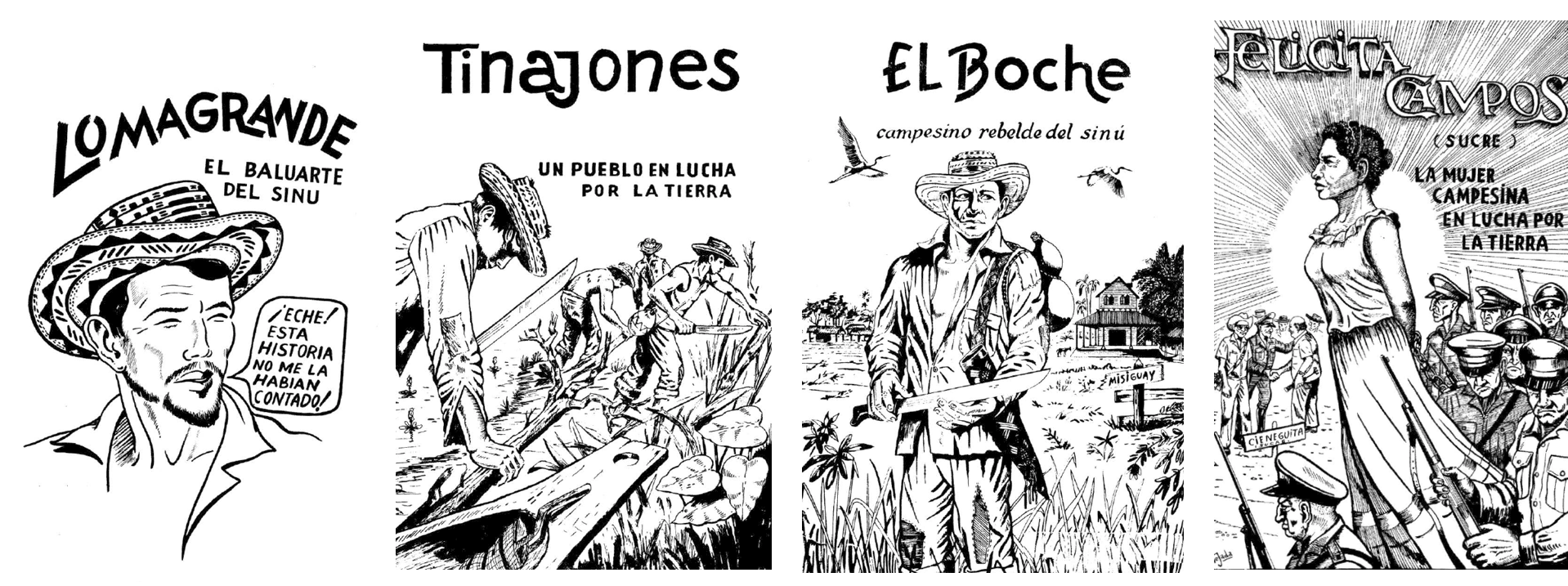
Fals Borda understood that for research to be useful to social movements, it had to be returned in accessible formats. That is where Ulianov Chalarka came in, a self-taught artist with enormous talent for portraiture and visual narrative. Chalarka did not sit in a studio inventing things. He went to the territory, listened to the peasants, observed what their houses, tools, and faces looked like. Then he translated all of that into panels.
Together, Fals Borda and Chalarka created four comics: Lomagrande, Tinajones, El Boche, and Felicita Campos. These were not mere illustrations; they were political tools. They were distributed at peasant assemblies, discussed, and used to organize the struggle for land. Drawing thus became an act of research and mobilization.
What interests us here is that Chalarka did not work alone. He was part of a multidisciplinary team: sociologists, historians, peasant leaders. His gaze, his pencil, synthesized everyone’s work. But he was not a mere translator. He was a co-researcher who made visual decisions with deep political implications. With questions like Whom do I put in the foreground? How do I show pain without falling into sensationalism? What details of the landscape are necessary to understand the struggle?
That lesson – of the illustrator as an active part of a research team – is what we wanted to recover and deepen in Historieta Doble.
- The researching gaze: the illustrator as co-researcher
In this section, I want to share with you five key aspects I have learned about the importance of collaboration between the illustrator and other professionals (scriptwriters, researchers, communities) in the creation of a nonfiction comic. Each aspect is a practical lesson coming from our experience with Historieta Doble.
Aspect 1: The illustrator is not a passive illustrator, but an active interpreter
When a researcher gives an academic text to an illustrator, they are not giving instructions to “draw what it says.” They are giving data, testimonies, emotions. The illustrator must read, ask, feel. They must be able to ask the researcher: What is the most important information here? What do you want the reader to feel in this scene? Visual translation is not automatic; it is interpretive.
Practical recommendation: In the first meetings of a project, establish a common vocabulary. The researcher should explain their theoretical framework; the illustrator should show visual references. The scriptwriter should translate that into sequences. It is a constant dialogue.
Aspect 2: The storyboard is a space for negotiation
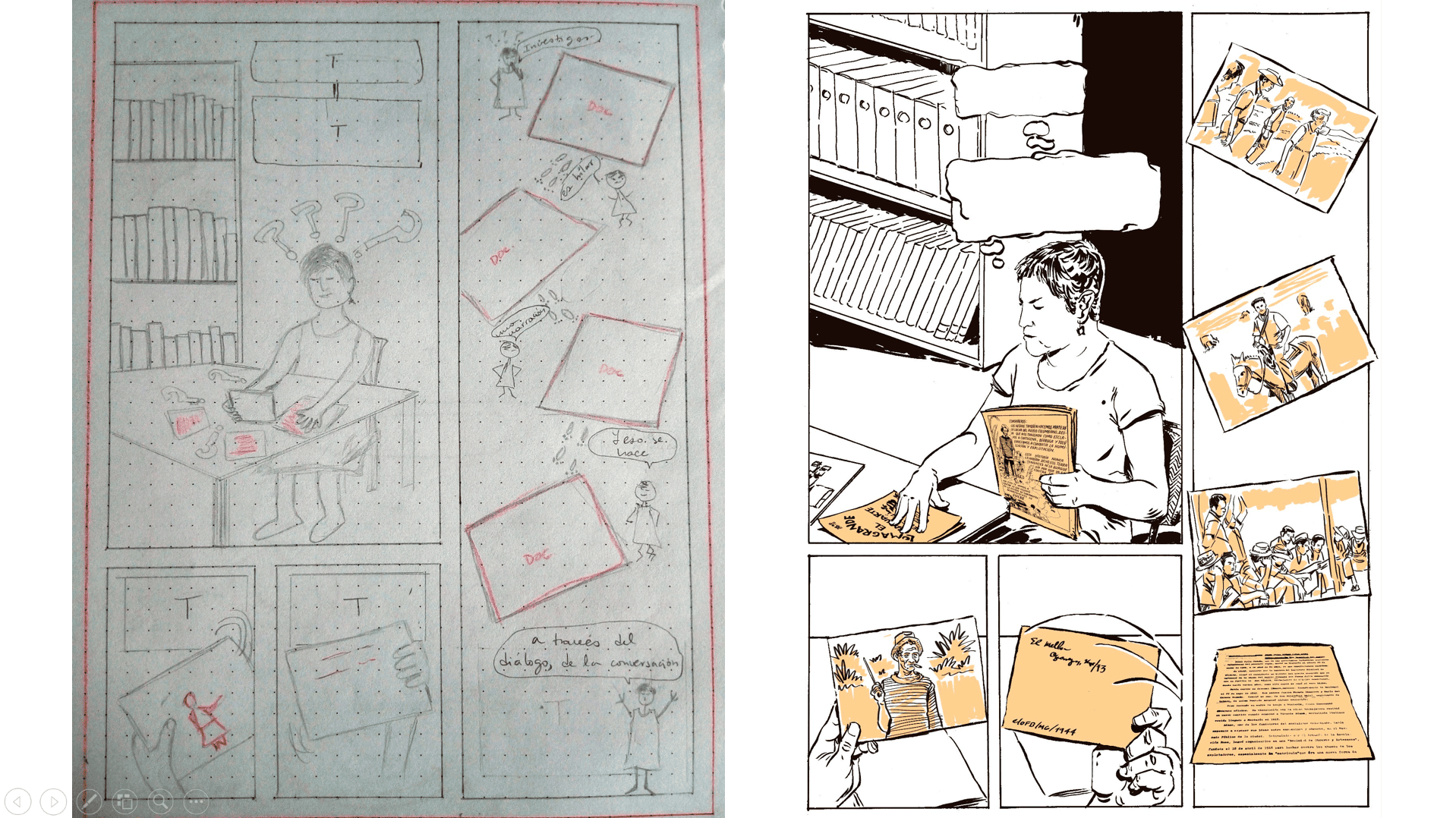
In Historieta Doble, Lina Flórez produced preliminary scripts with very simple stick figures (what is called a storyboard). Those scripts were not orders; they were proposals. Joanne, Lina, and I would meet and discuss panel by panel. Sometimes Joanne pointed out a historical mistake. Sometimes I said, “This panel doesn’t work visually because the emotion gets lost.” Sometimes Lina proposed reorganizing an entire page to give it more rhythm.
Practical recommendation: The storyboard should be a public draft, not a closed document. Schedule review sessions where all voices carry equal weight. The illustrator should feel free to suggest narrative changes; the researcher should feel free to correct factual accuracy.
Aspect 3: The division of labor does not imply hierarchy
A common temptation is to think that the researcher “thinks,” the scriptwriter “structures,” and the illustrator “executes.” That is a serious mistake. In our team, each person had a specialized skill, but all final decisions were consensual. For example, the decision to use colors to distinguish archival sources (sepia) from our reconstructions or evocations (lilac) and the narrative present (high-contrast black and white) was not merely aesthetic. It was a methodological decision we discussed for months. Joanne contributed historical rigor; Lina, narrative clarity; I, visual feasibility (fisability).
Practical recommendation: Define clear roles from the start, but make sure everyone understands the whole process. Organize periodic meetings where progress is shown and collective decisions are made. Trust is built by showing vulnerability: it is okay for an illustrator to admit not understanding a concept, or for a researcher to admit not knowing what a scene looks like.
Aspect 4: Validation with communities is part of the collaborative method
Chalarka did not draw in secret. He showed his progress to the peasants. They would tell him: “No, that house isn’t like that, the walls are made of wattle and daub,” or “We don’t wear that hat.” The drawing was adjusted. That is not censorship; it is ethnographic rigor.
In Historieta Doble, we traveled to the palenque of San José de Uré, a territory with a history of resistance. We showed our drafts to local leaders. They gave us valuable corrections. They even pointed out that one of our initial representations did not reflect the community’s ethnic diversity. We changed the drawing.
Practical recommendation: Whenever possible, validate the visual work with the people or communities represented. This not only improves accuracy but also builds trust and turns the comic into a legitimate archive for those who star in it.
Aspect 5: Time and expectation management is a collective task
A nonfiction comic takes time. A lot of time. Research, interviews, sketches, corrections. Researchers sometimes underestimate the illustrator’s work; illustrators sometimes underestimate the complexity of the data. The only way to avoid frustration is to plan together.
Practical recommendation: Create a realistic timeline from day one. Include shared milestones: script delivery, approved storyboard, pencils, inks, color. Review the timeline every month. Celebrate small achievements. Remember that the quality of collaboration is reflected in the quality of the final pages.
- From archive to panel: building a visual legacy
Now let us move to the concrete practice of how we built Historieta Doble from archives, testimonies, and collaborative dialogues. Here I also share five key aspects for the methodological development of a nonfiction comic from the illustrator-researcher-scriptwriter relationship.
Aspect 1: Color as an analytical tool, not decoration
In Historieta Doble we faced a central problem: how to show the reader what is an original source (a photo, a document, a comic by Chalarka) and what is our visual interpretation? The solution was color. Sepia for the sources; lilac for our reconstructions; a striped background for my contemporary interviews.
This decision was not arbitrary. We discussed it at length. Joanne insisted on not losing referentiality; I wanted the reader to understand the montage of memory; Lina sought fluid reading. The result was a visual code that teaches, without academic text, how history is built.
Practical recommendation: Before choosing a color palette, ask yourselves: What information do we want to convey with each color? How do we guide the reader’s gaze? Color is a language; use it with methodological intention.
Aspect 2: The page as a map of multiple times
One of the great advantages of comics is their ability to juxtapose times and spaces on the same page. In Historieta Doble we used this quality to show, for example, on the right side of the page, Juana Julia Guzmán (a peasant leader from the 1920s) narrating her story; on the left side of the page, Fals Borda in the 1970s analyzing her testimony; in the center, the characters evoked by the narrative meet; and at the bottom of the page, the character of Joanne appears in the present, analyzing, reading the documents and evidence that account for the historical characters. Everything happens on the same page.
Practical recommendation: When working with a scriptwriter, experiment with panel layout. Do not be afraid to break linearity. Comics allow the past and present to visually dialogue. That is something photography or video cannot do as naturally.
Aspect 3: The materiality of the archive as a visual resource
Not everything has to be drawn. In Historieta Doble we inserted reproductions of real documents: letters, yellowish photographs, pages from Fals Borda’s field notebooks. Those fragments are not decoration; they are evidence. The reader sees them and understands that what they are reading is anchored in the real.
Practical recommendation: Dialogue with the researcher to identify which archival documents are visually eloquent. Photograph or scan those materials. Then, the illustrator can integrate them into the page, respecting their texture and aura. This gives the comic a unique documentary density.
Aspect 4: Self-reflection on the process as part of the work
An unusual decision in Historieta Doble was to include documentary appendices, methodological essays, and interviews about our own creative process. That is, we not only tell the story of Fals and Chalarka; we also tell how we told it. This is very valuable for students and researchers because it shows doubts, mistakes, and solutions.
Practical recommendation: If the goal of your comic is also pedagogical or methodological, consider including a “behind the scenes” section. It can be a section at the end, or even intercalated panels where the illustrator appears reflecting on their work. This demonstrates honesty and teaches the craft.
Aspect 5: Returning to the community as the closure of the collaborative cycle
The last step of our research was to return the finished comic to the communities that appear in it. We did not do this as a symbolic gesture, but as part of the PAR method. We organized workshops where peasant leaders read Historieta Doble and gave us their opinions. Some pointed out nuances we had not captured. Others thanked us for making visible a story they knew but few document.
Practical recommendation: Do not conceive the comic as a final product that is delivered and forgotten. Design a return plan. It can be a commented reading session, a workshop, or even donating copies to community libraries. Collaboration does not end with publication; it continues in the social use of the book.
- Conclusion: The panel as a living archive and tool for the future
We have traveled a long path. From the gaze of Ulianov Chalarka in the 1970s to our own collaborative process in Historieta Doble. At every step, one idea remained firm: the illustrator’s gaze is the key for research not only to be documented, but to be felt, remembered, and mobilized.
A nonfiction comic is not a transcription of data. It is a visual construction where every line, every color, every framing decision is an informed interpretation. And that interpretation is richer, more rigorous, and more emotional when the illustrator works in dialogue with other professionals. The researcher contributes historical depth; the scriptwriter, dramatic structure; the illustrator, visual synthesis and graphic empathy. Together, they can create a rigorous and political archive – an archive made not only of papers, but of images (imech) that challenge, that hurt, that invite action.
Today, at this Training School in Coimbra, I invite you to imagine your own projects. Some of you have research skills but perhaps do not know how to draw. But you can seek out illustrators. You can learn to dialogue with them. You can understand that comics are not a “vulgarization” of science, but a way to expand it, to make it corporeal, to bring it back to the streets.
Just as Chalarka made his pencil a tool for peasant liberation, and just as our team in Historieta Doble tried to honor that legacy, you too can use panels to build memory, to question power, to ensure that academic knowledge does not stay locked in libraries, but circulates in the hands of those who need it most.
Thank you very much for your attention. I am open to questions, and especially to future collaborations. Drawing together is researching together. And that is the best way to transform the world.